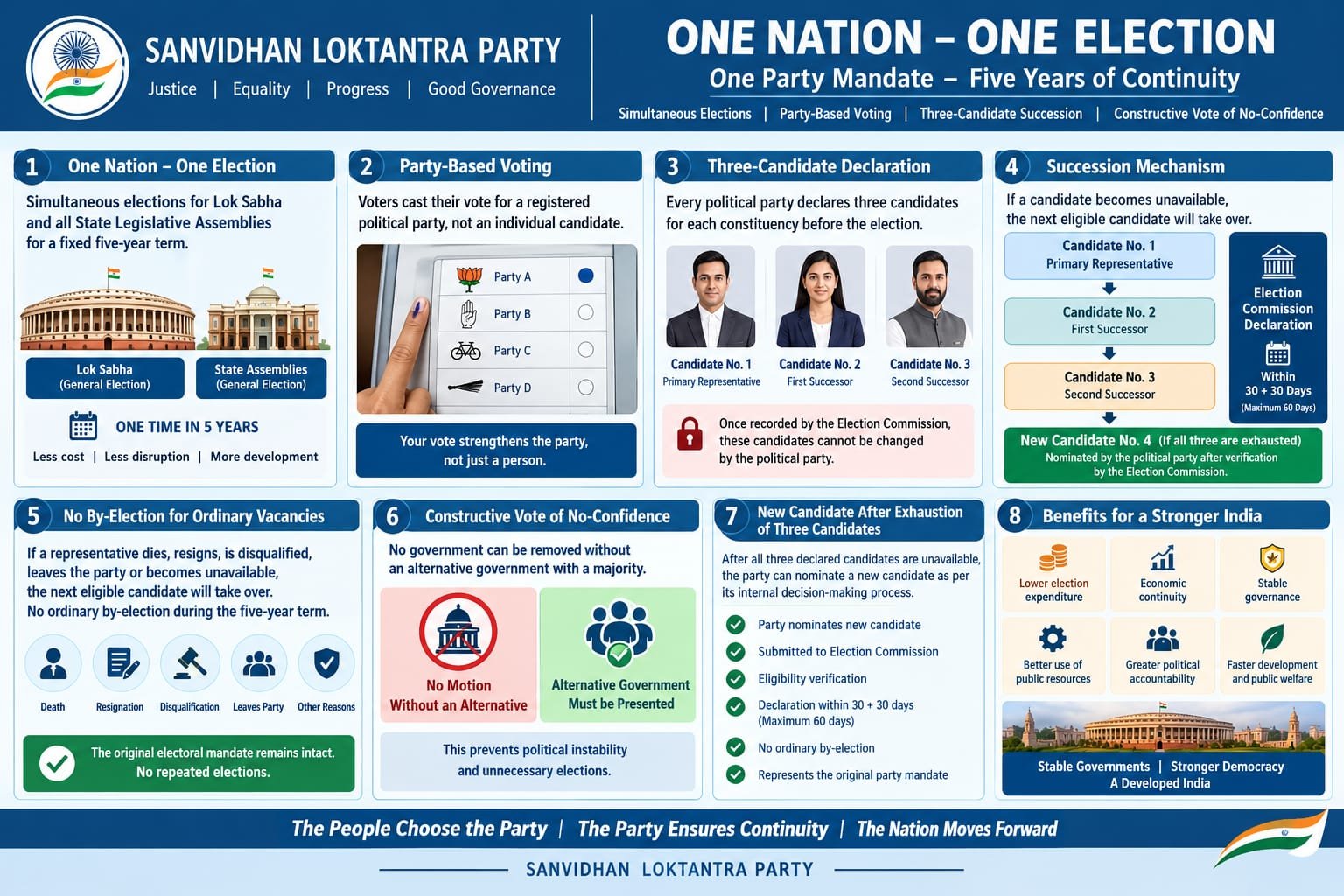
ONE NATION – ONE ELECTION
ONE PARTY MANDATE – FIVE YEARS OF CONTINUITY
National Electoral Reform Policy
ONE NATION – ONE ELECTION
One Party Mandate – Five Years of Government Stability
Proposed Policy: Simultaneous Elections | Party-Based Voting | Three-Candidate Succession | Constructive Vote of No-Confidence
1. Preamble
Sanvidhan Loktantra Party supports the concept of One Nation – One Election. We believe that simultaneous elections to the Lok Sabha and State Legislative Assemblies can help reduce repeated election expenditure, administrative disruption and interruptions to economic development.
However, merely conducting elections simultaneously does not completely address the possibility of premature government collapse, political instability and repeated elections during the remaining period of the five-year term.
Our Party therefore proposes a comprehensive electoral reform that addresses the structural weaknesses of the existing candidate-based electoral system.
Our fundamental principle is:
The electoral mandate belongs to the political party chosen by voters, and the mandate must remain protected throughout the complete five-year term.
Accordingly, Sanvidhan Loktantra Party proposes replacing individual candidate-dependent electoral representation with a transparent party-based voting and pre-declared succession mechanism, supported by a Constructive Vote of No-Confidence.
2. Core Principles of the Proposed Policy
The proposed system shall operate on the following principles:
- Simultaneous elections for Parliament and all State Legislative Assemblies for a common five-year electoral cycle.
- Voters shall cast their vote for a registered political party rather than an individual candidate as the primary electoral choice.
- Every political party shall declare three candidates for each constituency before the election.
- Once candidates are officially submitted and recorded by the Election Commission, the political party shall have no authority to change, replace or rearrange the declared candidates.
- The Election Commission shall maintain the official record of the three candidates and their succession order.
- If a vacancy arises, the next eligible pre-declared candidate shall be declared as the representative by the Election Commission within 30 days, with a maximum additional period of 30 days only where legally justified.
- No ordinary by-election shall be conducted for an individual vacancy during the five-year term.
- No government shall be removed through a no-confidence motion unless an alternative government with a demonstrated majority is simultaneously proposed and approved.
- The original party-wise electoral mandate shall remain protected throughout the five-year term, subject to constitutional safeguards.
3. Party-Based Voting System
Under the proposed system, the voter shall select a registered political party.
The party shall receive its electoral mandate according to the legally prescribed voting and seat-allocation mechanism.
The political party shall be accountable for its declared candidates, policies, governance commitments and performance during the entire five-year term.
The objective is to establish a direct relationship between the voter and the political party, ensuring that the original public mandate cannot be arbitrarily transferred through individual political movements.
The Election Commission shall prescribe a transparent system for:
- Party registration and eligibility.
- Party-wise vote counting.
- Allocation of seats.
- Publication of election results.
- Recording of the three declared candidates.
- Succession and replacement of representatives.
4. Mandatory Three-Candidate Declaration
Every registered political party participating in an election shall declare three candidates for each constituency.
Mandatory candidate declaration
- Candidate No. 1 — Primary Representative
The person who shall initially occupy the elected position.
- Candidate No. 2 — First Successor
The person who shall succeed Candidate No. 1 if a vacancy arises.
- Candidate No. 3 — Second Successor
The person who shall succeed Candidate No. 2 if a further vacancy arises.
All three candidates shall satisfy the applicable constitutional and statutory eligibility requirements.
Their names, affidavits, qualifications, declarations and other legally required particulars shall be submitted to the Election Commission before the election.
4.1 No Change of Declared Candidates by Political Parties
Once the Election Commission officially records the three candidates in the prescribed order, the political party shall have no right to:
- Change Candidate No. 1, 2 or 3.
- Replace any declared candidate with another person.
- Rearrange the succession priority.
- Introduce a new candidate after the election.
- Withdraw or cancel the declared succession arrangement for political convenience.
The declaration shall remain binding for the entire five-year electoral term.
Any correction before the final statutory deadline shall be subject to Election Commission procedures. After the official record is frozen, no political party shall independently alter the declared list.
Reason: The purpose of pre-declaring three candidates is to ensure that voters know in advance who will represent them if the primary representative cannot continue. Allowing a political party to change that list after the election would defeat the purpose of transparency and voter confidence.
5. Election Commission’s Official Record and Succession Procedure
The Election Commission shall maintain a permanent digital and official record of all three candidates declared by each registered political party for every constituency.
The record shall include:
- Candidate’s full name and identification particulars as legally required.
- Constituency details.
- Political party name.
- Succession priority.
- Eligibility and nomination status.
- Date of official registration.
- Any subsequent vacancy and succession order.
This record shall be publicly accessible, subject to applicable privacy and election laws.
5.1 Automatic Succession Within 30 + 30 Days
If Candidate No. 1 dies, resigns, becomes disqualified or otherwise ceases to hold office, the Election Commission shall initiate the succession procedure.
- The proposed timeline shall be:
First 30 days — Verification and declaration
The Election Commission shall verify the vacancy, eligibility and legal status of Candidate No. 2 and issue the succession declaration within 30 days.
Additional 30 days — Exceptional extension
Where a genuine legal or documentary difficulty prevents completion within the initial 30 days, the Election Commission may grant an additional period not exceeding 30 days, with written reasons recorded and made public.
Maximum period — 60 days
Candidate No. 2 shall be declared as the successor within a maximum of 60 days, subject to the prescribed legal procedure.
The same procedure shall apply when Candidate No. 2 is unable to continue and Candidate No. 3 becomes eligible to succeed.
The Election Commission, rather than the political party, shall exercise the authority to verify and declare the successor.
5.2 No Political Interference in Succession
The political party shall not have discretionary authority to nominate a different person after the vacancy.
The succession shall follow the original list submitted before the election.
The Election Commission shall act independently and shall not be required to obtain fresh political-party approval for declaring the next eligible candidate.
If all three candidates become unavailable or legally ineligible, the matter shall be referred to a special constitutional procedure prescribed by law. No arbitrary appointment by the political party shall be permitted.
6. No By-Election for Ordinary Vacancies
Under the proposed system, no by-election shall ordinarily be required when an elected representative:
- Dies.
- Resigns.
- Becomes disqualified.
- Leaves the political party.
- Is unable to perform the duties of office.
- Ceases to hold office for any other legally recognised reason.
The next eligible candidate from the pre-declared list shall succeed for the remaining portion of the original five-year term.
This will help preserve the electoral mandate without requiring repeated elections for the same constituency.
The system shall apply equally to Parliament and State Legislative Assemblies, subject to the necessary constitutional amendments.
7. Constructive Vote of No-Confidence — No Motion Without an Alternative Government
Sanvidhan Loktantra Party proposes a fundamental reform in the procedure for removing a government.
No political party or group shall be permitted to bring down an existing government merely by expressing opposition or passing a no-confidence motion without presenting an alternative government capable of securing a majority.
The proposed system shall be known as the Constructive Vote of No-Confidence.
7.1 Mandatory Conditions
A no-confidence motion shall be admissible only when:
- The moving members identify the proposed alternative Chief Minister or Prime Minister, as applicable.
- The proposed alternative government is supported by the constitutionally required majority.
- The supporting members formally declare their support.
- The alternative government is presented for consideration at the same time as the motion against the existing government.
- The House votes on the removal of the existing government and approval of the alternative government through a prescribed constitutional procedure.
7.2 No Government Collapse Without Replacement
If the proposed alternative government fails to demonstrate the required majority, the existing government shall continue in office, subject to constitutional law.
A no-confidence motion shall not be used merely to create political instability, force repeated elections or obstruct government functioning.
7.3 No Individual Defection to Alter the Original Mandate
Under the proposed party-based voting system, an individual representative leaving a political party shall not automatically transfer the party’s original electoral seat or mandate to another political party.
The pre-declared succession arrangement shall operate where the individual ceases to hold office, subject to constitutional safeguards.
The objective is to ensure that government formation and continuation depend upon the voters’ original party-based mandate and not individual political bargaining.
8. Protection of the Five-Year Electoral Cycle
The proposed policy aims to ensure that elections are conducted once during the regular five-year electoral cycle.
The following situations shall not ordinarily trigger fresh elections:
| Situation | Proposed solution |
|---|---|
| Death of primary candidate | Candidate No. 2 succeeds |
| Disqualification of primary candidate | Candidate No. 2 succeeds |
| Resignation of primary candidate | Candidate No. 2 succeeds |
| Candidate leaves the party | Succession as prescribed by law |
| Candidate No. 2 becomes unavailable | Candidate No. 3 succeeds |
| Government faces a no-confidence motion | Alternative government must be presented |
| Government loses political support | Constructive vote procedure applies |
| Individual constituency vacancy | No ordinary by-election |
The five-year term shall remain the foundation of the electoral cycle.
However, the policy shall not prevent constitutional intervention in exceptional circumstances where government formation becomes genuinely impossible or constitutional governance cannot continue.
9. Protection Against Political Horse-Trading
Sanvidhan Loktantra Party believes that the electoral mandate should not become a matter of political bargaining after the election.
The proposed system shall include safeguards against:
- Inducement of elected representatives to change political allegiance.
- Manipulation of party representation.
- Artificial creation of vacancies.
- Political replacement of pre-declared candidates.
- Repeated no-confidence motions without an alternative government.
- Unnecessary expenditure on repeated elections.
Any violation shall be dealt with through transparent legal procedures, independent investigation and appropriate constitutional remedies.
10. Financial and Economic Objectives
The purpose of One Nation – One Election should not be limited to reducing the number of election dates.
It should also ensure continuity in administration and development.
Sanvidhan Loktantra Party expects the proposed reforms to contribute towards:
A. Reduction in election-related expenditure
Avoiding ordinary by-elections and repeated elections during the same five-year term may reduce expenditure on election arrangements.
B. Economic continuity
Government departments, public institutions and development projects should be able to function without frequent election-related administrative interruptions.
C. Better utilisation of public resources
Financial and administrative resources can be directed towards infrastructure, education, healthcare, employment and public welfare.
D. Stable policy implementation
Long-term government policies and development programmes should receive continuity during the original electoral term.
E. Greater political responsibility
Political parties shall be accountable for the candidates and policies they declare before elections.
These objectives shall be evaluated through independent financial and administrative assessments after implementation.
11. Constitutional Safeguards and Democratic Rights
Our Party believes that government stability must never be achieved at the cost of democracy.
Therefore, the proposed reforms shall preserve:
- Constitutional supremacy.
- Independent Election Commission.
- Judicial review.
- Fundamental rights.
- Freedom of expression.
- Right to peaceful political opposition.
- Legislative scrutiny.
- Financial accountability of governments.
- Public access to information.
- Legal remedies against arbitrary decisions.
The Constructive Vote of No-Confidence is intended to prevent government removal without a viable alternative, not to make any government permanently immune from democratic accountability.
Similarly, party-based voting shall not remove the constitutional responsibility of elected representatives to perform their legislative duties independently and lawfully.
12. Special Constitutional Mechanism for Exceptional Circumstances
Sanvidhan Loktantra Party recognises that no electoral system can completely eliminate every exceptional political or constitutional situation.
Therefore, a special mechanism shall be prescribed for circumstances such as:
- All three declared candidates becoming unavailable.
- A party becoming legally ineligible to hold representation.
- No alternative government being capable of securing the required majority.
- Constitutional breakdown or failure of constitutional machinery.
- Any situation requiring intervention under the Constitution.
Such exceptional provisions must be narrowly defined and must not become an indirect method of conducting repeated elections.
Where a fresh election becomes constitutionally unavoidable, it should ordinarily be limited to the remaining unexpired term, in accordance with the applicable constitutional framework.
13. Implementation and Constitutional Amendments
The proposed system shall require comprehensive constitutional and statutory reform.
Sanvidhan Loktantra Party proposes that the Government of India initiate a detailed legislative examination involving:
The Election Commission of India.
Constitutional experts.
- Parliamentary representatives.
- State Legislative Assemblies.
- Legal and electzoral reform institutions.
- Public consultation.
The amendments should specifically address:
- Party-based voting and seat allocation.
- Three-candidate pre-declaration.
- Binding candidate succession records.
- Election Commission authority to declare successors.
- The 30-day succession deadline and exceptional additional 30-day period.
- Prevention of political alteration of declared candidates.
- Constructive Vote of No-Confidence.
- Protection of the original five-year electoral cycle.
- Exceptional constitutional procedures.
The proposed 30 + 30-day succession mechanism must be supported by clear statutory deadlines, independent verification and remedies against unjustified delay.
14. Comparative Illustration: Existing Concern and Proposed Solution
Situation: State Government faces instability in the fourth year
Concern under an election system without adequate safeguards
Government loses majority → Political instability → Possibility of premature dissolution → Election for remaining term → Additional public expenditure and administrative arrangements.
Sanvidhan Loktantra Party’s proposed solution
Party-based mandate → Three pre-declared candidates → Automatic succession through Election Commission → Constructive Vote of No-Confidence → Alternative government must be demonstrated → Original electoral cycle protected.
15. Final Declaration of Sanvidhan Loktantra Party
Sanvidhan Loktantra Party supports One Nation – One Election as a national electoral reform.
However, we believe that simultaneous elections alone cannot fully achieve the objectives of electoral stability and economic continuity unless the possibility of unnecessary government collapse and repeated elections is also addressed.
Our Party therefore proposes a new electoral framework based on party-based voting, mandatory declaration of three candidates, binding succession arrangements and a Constructive Vote of No-Confidence.
We believe that a political party must declare its representatives before asking citizens for their votes. Once the Election Commission officially records those candidates, the party must not be permitted to change them for political convenience.
If a representative becomes unavailable, the Election Commission shall declare the next eligible pre-declared candidate within 30 days, with a maximum additional period of 30 days in exceptional circumstances.
Similarly, no political party should be allowed to remove an existing government through a no-confidence motion without simultaneously presenting an alternative government capable of securing the required majority.
Our objective is to protect the people’s electoral mandate, reduce avoidable election expenditure, ensure continuity of governance and strengthen democratic accountability.
We do not believe that electoral reform should merely change when elections are conducted. It should also reform how political representation is maintained throughout the five-year term.
No Motion Without an Alternative Government
Stable Governance • Democratic Accountability • Economic Continuity
Drafting note for adoption: The most important legal distinction is that your proposal must define whether party-based voting means proportional allocation of seats across constituencies or a party’s fixed three-person panel for each constituency. These are different electoral models. The policy above treats the three-person panel as a constituency-level succession mechanism and leaves the exact seat-allocation formula for constitutional legislation. This should be settled before presenting the policy as a final constitutional amendment proposal.