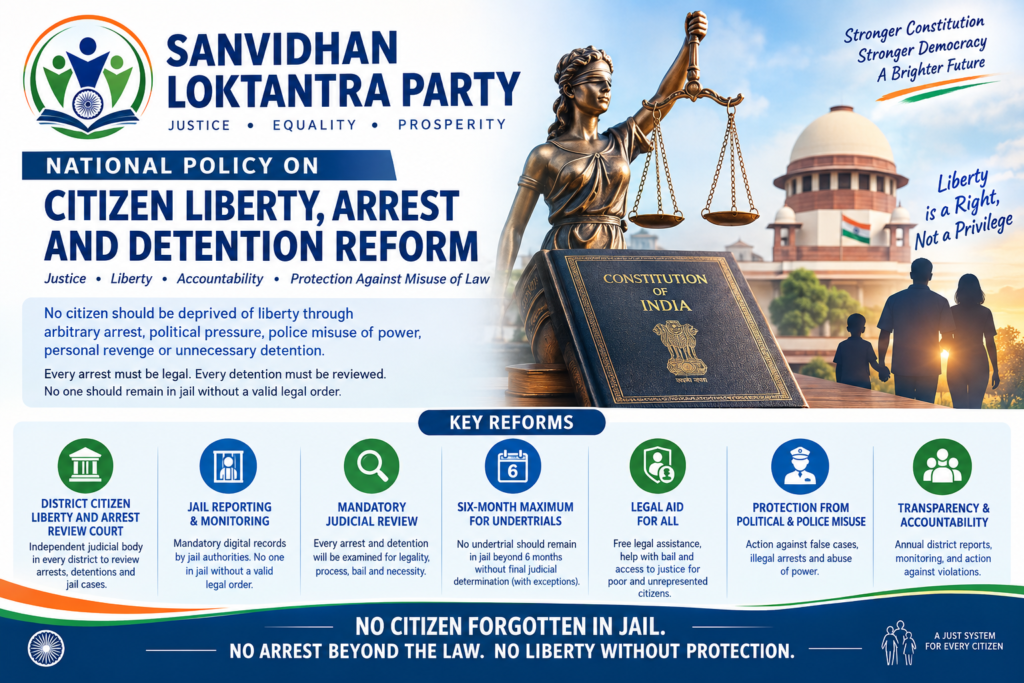
NATIONAL POLICY ON CITIZEN LIBERTY, ARREST AND DETENTION REFORM
Justice • Liberty • Accountability • Protection Against Misuse of Law
Our Fundamental Principle
Personal liberty is a fundamental right of every citizen. No person should be deprived of liberty through arbitrary arrest, political pressure, police misuse of power, personal revenge or unnecessary judicial detention.
The Sanvidhan Loktantra Party believes that the protection of citizens’ liberty is not merely the responsibility of the individual accused or their lawyer. It is also a responsibility of the State, the police, the prison authorities and the judicial system.
An ordinary citizen should not be compelled to approach the High Court in every case merely to obtain protection against illegal arrest, unlawful detention, denial of bail or unnecessary imprisonment.
The party proposes a dedicated district-level judicial mechanism to ensure that every arrest and detention is legally justified, continuously monitored and subject to effective judicial supervision.
1. Establishment of District Citizen Liberty and Arrest Review Court
The party proposes the establishment of a dedicated District Citizen Liberty and Arrest Review Court in every district, through appropriate legislation and judicial arrangements.
Its primary responsibility shall be to protect citizens from unlawful arrest, unnecessary detention and misuse of criminal law.
The proposed court shall:
- Independently examine the legality and necessity of arrests.
- Review police custody and judicial custody.
- Examine whether arrest procedures have been properly followed.
- Ensure that every person in jail has a valid legal and judicial basis for detention.
- Monitor undertrial prisoners who remain in jail for prolonged periods.
- Ensure access to bail, legal assistance and timely judicial remedies.
- Take suo motu cognizance of unlawful or prolonged detention.
The proposed mechanism shall function under judicial authority and shall not be controlled by the police, government or prison administration.
2. Mandatory Reporting Responsibility of District Jail Authorities
The District Jail Superintendent shall have a mandatory responsibility to report the legal status of every person admitted to or detained in jail.
The jail authorities shall maintain a complete digital record containing:
- Name and identity of the prisoner.
- Date and time of arrest.
- Police station and investigating authority.
- FIR number and applicable sections.
- Date of production before the Magistrate.
- Copy and validity of remand orders.
- Current judicial custody status.
- Date of filing of charge-sheet.
- Bail eligibility and bail application status.
- Duration of detention.
- Next hearing date.
- Availability of legal assistance.
No person shall remain in jail without a valid and subsisting legal authority for detention.
The Jail Superintendent shall immediately report any missing, expired, defective or questionable detention order to the District Citizen Liberty and Arrest Review Court for appropriate judicial examination.
3. Mandatory Judicial Review of Every Arrest and Detention
The proposed court shall establish a system for reviewing every arrested person’s legal status.
The review shall cover:
- Whether the arrest was authorised by law.
- Whether the arrest was necessary under the circumstances.
- Whether mandatory arrest procedures were followed.
- Whether the accused was informed of the grounds of arrest.
- Whether the person was produced before the competent Magistrate within the prescribed period.
- Whether police or judicial custody was properly authorised.
- Whether the remand order contains legally sustainable grounds.
- Whether continued detention is necessary and proportionate.
- Whether the person is eligible for bail or release.
- Whether the investigation and trial are being unnecessarily delayed.
The proposed court shall not interfere with the independent judicial decision-making of the competent criminal courts. Its purpose shall be to ensure compliance with constitutional safeguards and provide an effective remedy against unlawful detention.
4. Suo Motu Judicial Intervention and Citizen’s Right to Apply
The most important feature of this reform shall be the power of the proposed court to initiate proceedings suo motu.
A citizen should not be required to understand complicated legal procedures or approach the High Court merely to bring an unlawful detention to the attention of the judicial system.
The proposed court shall be empowered to initiate review:
- Suo motu, upon receiving information about questionable detention.
- On an application by the arrested person or undertrial prisoner.
- Through an application by a family member or legal representative.
- Through a report submitted by the Jail Superintendent.
- Through a report from the District Legal Services Authority.
- Upon receiving information about illegal arrest, police misconduct or procedural violations.
Applications shall be accepted through simple written applications, legal aid lawyers and an accessible jail-based application mechanism.
No application shall be rejected merely because the prisoner lacks legal knowledge, financial resources or professional drafting assistance.
5. Six-Month Maximum Undertrial Detention Reform
The party proposes a special statutory protection to prevent citizens from remaining in jail for years without final adjudication.
Proposed principle: No undertrial prisoner should ordinarily remain in jail beyond six months without a final judicial determination of the case.
For implementation:
- Every undertrial detention shall undergo a mandatory review before completion of six months.
- The court shall examine the reasons for delay in investigation or trial.
- The court shall consider whether the accused can be released on bail or personal bond.
- Where continued detention is claimed to be necessary, the competent court must examine the specific reasons and pass a reasoned judicial order.
- Exceptional cases involving serious offences or other legally recognised circumstances shall be considered individually.
- The State shall be accountable for unnecessary delays caused by administrative or investigative failures.
This shall be a proposed additional statutory safeguard and shall operate consistently with constitutional requirements and existing bail provisions, including Section 479 of the BNSS.
6. Protection of Poor and Legally Unaware Prisoners
The party recognises that many undertrial prisoners remain in jail not because their continued detention has been independently examined, but because they lack money, legal knowledge, family support or effective legal representation.
The proposed court shall ensure:
- Free legal assistance to every eligible prisoner.
- Immediate appointment of legal aid counsel wherever required.
- Assistance in filing bail applications.
- Review of excessive or unaffordable bail conditions.
- Assistance to prisoners unable to furnish financial sureties.
- Communication of legal rights in a language understood by the prisoner.
- Periodic interaction with prisoners to identify cases requiring urgent judicial intervention.
No citizen should continue to suffer imprisonment merely because they are poor or unable to afford a private advocate.
7. Protection Against Political Pressure and Police Misuse
Police powers are essential for maintaining law and order, but those powers must never become instruments of harassment, intimidation or personal revenge.
The proposed judicial review mechanism shall examine allegations involving:
- Arrests motivated by political pressure.
- Personal disputes converted into criminal proceedings.
- False or fabricated allegations.
- Unnecessary arrests despite the availability of lawful alternatives.
- Failure to follow arrest procedures.
- Illegal detention or custody beyond authorised limits.
- Deliberate obstruction of bail or release.
- Abuse of police authority against ordinary citizens.
Where violations are established, the competent authorities shall initiate appropriate departmental, civil or criminal proceedings in accordance with law.
8. Automatic Review of Bail and Release Orders
The proposed court shall maintain a monitoring mechanism to ensure that judicial orders granting bail or release are implemented without unnecessary delay.
Where a prisoner is not released despite an effective bail or release order, the jail authorities shall immediately report the matter to the proposed court.
The court shall examine whether the delay is due to:
- Failure to communicate the order.
- Financial inability to comply with bail conditions.
- Administrative negligence.
- Incorrect interpretation of the release order.
- Any other legally unjustified reason.
Appropriate directions shall be issued by the competent judicial authority.
9. Continuous Monitoring of Undertrial Prisoners
The proposed court shall maintain a district-wide digital undertrial monitoring system.
Every prisoner shall have a detention timeline showing arrest, remand, charge-sheet, bail proceedings, trial progress and expected review dates.
The court shall prioritise:
- Prisoners detained for more than six months.
- Prisoners whose trial has not commenced.
- Prisoners unable to obtain legal assistance.
- Prisoners whose bail applications remain pending.
- Prisoners detained beyond the statutory period applicable to their offence.
- Prisoners who may be entitled to release under existing law.
The District Jail Superintendent shall submit regular reports and shall be accountable for the accuracy and timely submission of information.
10. Judicial Accountability and Independent Monitoring
The proposed court shall function independently, with judicial officers appointed or assigned through the legally prescribed judicial mechanism.
The police, District Administration and Jail Authorities shall provide complete cooperation and records.
The court shall have appropriate statutory powers to:
- Call for records and explanations.
- Examine detention-related complaints.
- Direct production of prisoners where legally required.
- Refer matters to competent criminal courts.
- Recommend or initiate appropriate action for violations.
- Ensure that eligible prisoners receive legal aid and access to bail proceedings.
The mechanism shall complement, not replace, existing Magistrate Courts, Sessions Courts, High Courts, District Legal Services Authorities and Undertrial Review Committees.
11. Public Transparency and Annual Reporting
Every district shall publish an annual anonymised report regarding:
- Total undertrial prisoners.
- Prisoners detained beyond six months.
- Cases of prolonged detention.
- Arrest-related procedural violations identified.
- Bail and release applications reviewed.
- Prisoners provided free legal assistance.
- Unlawful detention complaints.
- Action taken on violations.
This will create institutional accountability without disclosing confidential personal information.
Our Commitment to Every Citizen
LIBERTY IS NOT A PRIVILEGE. IT IS A RIGHT.

The Sanvidhan Loktantra Party commits to a justice system where:
- No arrest is beyond judicial scrutiny.
- No detention continues without valid legal authority.
- No poor citizen is deprived of justice due to lack of money.
- No undertrial prisoner is forgotten inside a jail.
- No police authority is above the law.
- No citizen is forced to approach the High Court merely to obtain basic protection against unlawful detention when an effective district-level remedy can be provided.
Our objective is not to protect any accused person from lawful investigation or prosecution. Our objective is to protect every innocent and accused citizen from unlawful deprivation of liberty, while ensuring that justice is delivered through fair, transparent and constitutionally valid procedures.
Legal Foundation and Existing Framework
This reform builds upon the constitutional protection of personal liberty under Articles 21 and 22, arrest safeguards under the BNSS, and existing undertrial review mechanisms.
India already has district-level Undertrial Review Committees involving judicial and administrative authorities. The proposed policy seeks to strengthen this framework by introducing a dedicated judicial remedy, mandatory reporting, accessible applications and more continuous monitoring.
The existing Section 479 of BNSS provides statutory undertrial release protections based on a proportion of the maximum sentence, subject to its conditions. The proposed six-month review is intended as an additional safeguard, not a replacement for those protections.
“No Citizen Forgotten in Jail. No Arrest Beyond the Law. No Liberty Without Protection.”