Why It Is Needed
The Press and News Media are widely regarded as the fourth pillar of democracy, with a vital role in informing citizens, questioning those in power, and bringing public issues to light. However, despite this important constitutional and democratic function, the Press and News Media have no formal representation in the country’s decision-making process.
To strengthen democracy, there is a need to ensure that the Press and News Media can participate independently in matters concerning the functioning of democratic institutions and public accountability. Such participation can provide an informed, transparent, and independent perspective in the decision-making process while helping protect the freedom and independence of the media.
Independent media should not merely report on democracy; it should also have an appropriate institutional voice in strengthening and protecting it.
Independent Press & News Media Representation
A Democratic Voice for the Fourth Pillar
The Press and News Media play a fundamental role in informing citizens, exposing wrongdoing, questioning those in authority and protecting democratic accountability. The Press Council of India is already established by law to preserve press freedom and maintain professional standards of newspapers and news agencies. However, the Press and News Media do not have directly elected representatives within the legislative decision-making process.
Our Proposal
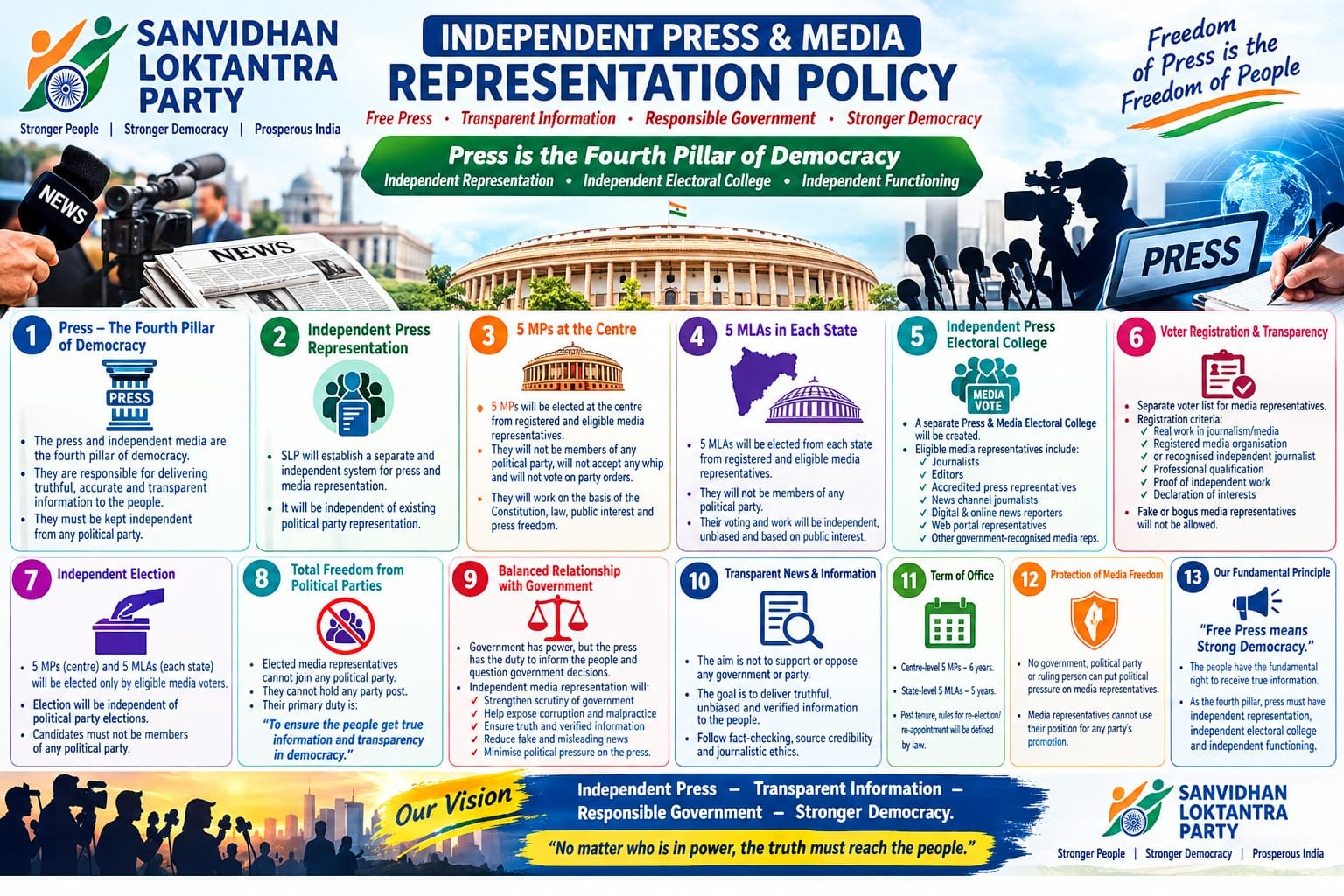
We propose the creation of Independent Press & News Media Seats in Parliament and State Legislative Assemblies.
- 10 reserved Media Representatives in the Lok Sabha
- 10 reserved Media Representatives in every State Legislative Assembly
- These representatives shall be elected without any political-party symbol.
- Their voters shall be drawn exclusively from an independent statutory electoral register of eligible Press and News Media professionals.
- They shall not represent any political party, government or individual media organisation.
Independent Legislative Representation
The purpose of these seats is not to create another political party inside the legislature. Each Media Representative shall exercise an independent legislative judgment.
They shall be free to support or oppose any government, opposition party or legislative proposal according to the Constitution, democratic principles, public interest and the national interest.
No political party shall have the right to issue a party whip to a Media Representative.
Democratic Safeguard
The Media Representatives shall have a special responsibility to examine legislation and governmental actions affecting:
- Constitutional democracy
- Freedom of expression and press freedom
- Electoral democracy
- Transparency and accountability
- Independence of democratic institutions
- Citizens’ fundamental democratic rights
- Access to public information
- National democratic security
For major legislation affecting these areas, the Media Representatives may publish an independent Democratic Impact Report, presenting the constitutional, democratic and public-interest implications of the proposed measure.
Protection from Political and Commercial Influence
To preserve independence, Media Representatives shall be subject to strict conflict-of-interest and transparency requirements.
They shall not:
- hold an office in a political party;
- accept political-party funding;
- use their legislative position to promote a particular media organisation;
- receive improper benefits from government or political organisations; or
- conceal financial or professional conflicts of interest.
Their independence must be protected not only from political parties and governments, but also from excessive influence by media owners and commercial interests.
The Principle
The objective is not to make the Press and News Media a political force.
The objective is to give the Fourth Pillar an independent institutional voice inside the democratic decision-making system.
Political representatives represent political mandates.
Media representatives represent independent public-interest scrutiny.
Their ultimate responsibility shall be:
Constitution First — Democracy First — Public Interest First — India First.
Proposed Policy: Independent Press & News Media Representation
1. Reserved Media Seats
Create a separate category of Independent Press & News Media Representatives:
- Lok Sabha: 10 reserved seats at the national level.
- Every State Legislative Assembly: 10 reserved seats.
- These seats would be in addition to the ordinary elected seats, subject to the constitutional and electoral framework required to establish them.
- The representatives would not contest on a political-party symbol.
2. Election Only by the Media Community
The most distinctive part of your proposal could be the electorate. The five representatives would be elected only by eligible members of the registered Press and News Media community, rather than by the general electorate. A statutory National and State Media Electoral Register could be created.
Eligible voters could include, subject to defined professional criteria:
- Editors
- Working journalists
- Reporters
- News-agency journalists
- Accredited digital-news journalists
- Investigative journalists
- Other professionally recognised news-media personnel
This would make the representatives accountable to the professional media community, rather than to a political party.
3. No Political-Party Symbol
A candidate for a Media Seat would:
- not receive a political-party election symbol;
- not contest as a candidate of any political party;
- not be permitted to hold a political-party office while serving;
- disclose financial, ownership and professional interests;
- take an oath to uphold the Constitution, democracy, freedom of expression, national security and public interest.
The constitutional principle should be independence, not neutrality on every issue. A media representative should be free to support or oppose a government proposal based on constitutional and public-interest considerations.
4. They Should Not Become a “Media Party”
This is particularly important. The five representatives should not be required to vote together as a bloc. Each representative should have an independent vote.
For example: – If the government introduces a law affecting freedom of expression, one media representative may support it, while another may oppose it. That would preserve genuine independence rather than creating another political group inside Parliament.
5. Constitutional-Democracy Mandate
Their special statutory/constitutional mandate could be: – To examine legislation and governmental actions from the perspective of constitutional democracy, freedom of expression, transparency, accountability, public information, institutional independence and the protection of democratic institutions.
- They should not have a mandate to support a particular government or oppose a particular political party.
- Their loyalty should be to: Constitution → Democracy → Public Interest → Freedom of Expression → National Interest
- rather than: Political Party → Government → Opposition
6. Special “Democratic Safeguard” Role
This could make your proposal much more unique. The five Media Representatives could have a statutory right to issue a Democratic Impact Report on important legislation.
Before major legislation concerning matters such as:
- freedom of speech;
- elections;
- media freedom;
- constitutional institutions;
- access to public information;
- democratic rights;
- censorship;
- emergency powers;
- independence of constitutional bodies;
the Media Representatives could collectively or individually publish their constitutional and democratic assessment. However, the report should not automatically have veto power. Parliament should remain the final legislative authority unless the Constitution itself provides otherwise.
7. Protection from Government and Media Owners
This is essential to make your idea credible.
An elected media representative could be vulnerable to two different forms of pressure:
- Political pressure: government or political parties.
- Corporate/media-owner pressure: newspaper owners, television networks, digital platforms or large media corporations.
Therefore, the policy should prohibit a sitting Media Representative from:
- holding a political-party position;
- accepting political-party funding;
- receiving government-paid political appointments;
- using the position to promote a particular media company;
- voting on matters in which the representative has a direct financial conflict without disclosure.
A Media Ethics and Independence Commission could monitor these conflicts.
The existing Press Council already has statutory objectives relating to press independence, professional standards and responsible journalism, so your proposed system could build on—not necessarily replace—that institutional framework
8. A particularly strong safeguard: “No Party Whip”
Political-party representatives can be subject to party discipline. Media Representatives should not be subject to any political-party whip. Their vote must be their own constitutional judgment.
Every elected Press and News Media Representative shall have the right and duty to exercise an independent legislative judgment without direction, instruction or whip from any political party, government or private media organisation.
9. Suggested Election Structure
I would make the system two-stage:
- Stage 1 – Nomination – Eligible journalists/media professionals can nominate candidates.
- Stage 2 – Media Election- Only registered eligible media voters vote.
For example:
All eligible media voters → elect 10 Media Representatives → Parliament/Assembly
The Election Commission could conduct the election to maintain an independent electoral process.
The Constitution currently provides the ordinary constitutional framework for Parliament and State Legislatures, so creating additional elected legislative seats would require careful constitutional and statutory design rather than simply an ordinary party policy
10. Recognised News Media
Today’s news ecosystem includes print, television, news agencies and digital journalism. The Press Council’s present statutory structure itself is primarily oriented toward newspapers and news agencies
An independent professional organisation or journalist engaged in the regular collection, verification, investigation, analysis and dissemination of news and public-interest information through print, television, radio, news agencies or digital news platforms, subject to transparent statutory eligibility standards.
Recognised Press and News Media
In the digital age, the Press and News Media are no longer limited to newspapers, television and radio. Journalism and public-interest news are now also carried through digital platforms such as YouTube, websites and blogs, podcasts, Instagram, Telegram and other emerging media platforms.
For the purpose of Independent Press and News Media Representation, Recognised Press and News Media shall include individuals and organisations engaged in regular, original and responsible news reporting, investigative journalism, public-interest journalism, current-affairs reporting, fact-based analysis and dissemination of information of public importance, whether through print, television, radio or digital media.
This may include:
- Newspapers and magazines
- Television and radio news organisations
- News agencies
- Independent journalists
- Digital news organisations
- YouTube news and journalism channels
- Independent news websites and blogs
- News and public-affairs podcasts
- Journalists and news publishers using Instagram, Telegram and other digital platforms
However, merely being a social-media user or content creator shall not make a person a member of the recognised news media. Entertainment channels, influencers, promotional accounts, personal blogs, advertising channels and political campaign or propaganda platforms shall not qualify solely because they publish content online.
Eligibility for voting or contesting for the proposed Independent Press and News Media Seats shall be determined through transparent statutory criteria based on professional journalism, regular news activity, original content, public-interest reporting, disclosure of ownership and funding, and adherence to an independent journalistic code of ethics.
The definition shall remain platform-neutral, so that the recognition of journalism depends on its function and professional standards, not on the technology or platform through which news is delivered.
The Principle
The Fourth Pillar must include every genuine form of journalism—whether it is printed on paper, broadcast on television, published on a website, or delivered through a digital platform.
What matters is not the platform.
What matters is independent journalism, truthful information, public interest and democratic accountability.