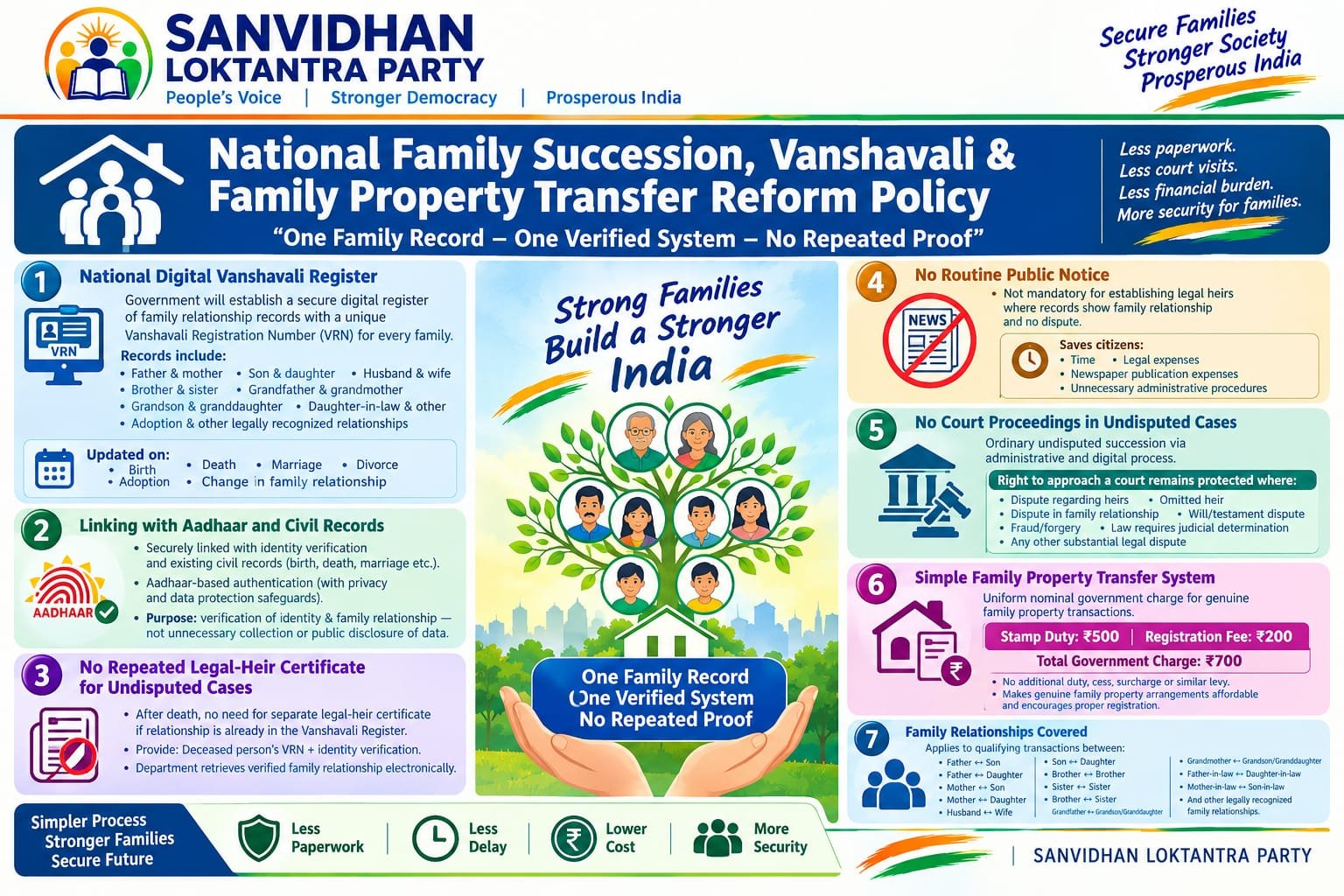
National Family Succession, Vanshavali & Family Property Transfer Reform Policy
“One Family Record – One Verified System – No Repeated Proof”
Sanvidhan Loktantra Party proposes a National Family Vanshavali and Succession Reform System to eliminate unnecessary government procedures, repeated documentation, avoidable court proceedings and excessive financial burdens on ordinary citizens after the death or transfer of property within a family.
At present, citizens are often required to obtain legal-heir certificates, succession certificates, affidavits, newspaper public notices and other documents, and may have to approach courts or government offices merely to establish family relationships that could be maintained in a secure government database.
The Sanvidhan Loktantra Party proposes to replace this outdated system with a National Digital Vanshavali Register.
1. National Digital Vanshavali Register
The Government of India shall establish a secure National Digital Vanshavali Register containing the verified family relationship records of citizens.
Every family shall have a unique Vanshavali Registration Number (VRN).
The system shall record legally relevant family relationships, including:
- Father and mother
- Son and daughter
- Husband and wife
- Brother and sister
- Grandfather and grandmother
- Grandson and granddaughter
- Daughter-in-law and other legally recognized family relationships
- Adoption and other legally recognized relationships.
The system shall be continuously updated when there is a:
- Birth
- Death
- Marriage
- Divorce
- Adoption
- Change in legally recognized family relationship.
2. Linking with Aadhaar and Civil Records
The Vanshavali Register shall be securely linked with identity verification and the existing civil-registration system, including birth, death, marriage and other legally recognized records.
Aadhaar-based authentication may be used for identity verification, subject to applicable privacy, data-protection and constitutional safeguards.
The purpose shall be verification of identity and family relationship—not unnecessary collection or public disclosure of personal information.
3. No Repeated Legal-Heir Certificate for Undisputed Cases
After the death of a family member, surviving family members should not be required to obtain a separate legal-heir certificate merely to prove a family relationship that is already recorded and verified in the National Vanshavali Register.
The applicant may provide: Deceased person’s Vanshavali Registration Number + identity verification.
The concerned government department or authorized institution shall retrieve the verified family relationship electronically.
4. No Routine Public Notice
Where the government records establish the family relationship and there is no dispute or competing claim, publication of a newspaper public notice should not be mandatory merely for establishing legal heirs.
This will save citizens:
- Time
- Legal expenses
- Newspaper publication expenses
- Unnecessary administrative procedures.
5. No Court Proceedings in Undisputed Cases
An ordinary undisputed family succession should be capable of being completed through an administrative and digital process.
However, the right to approach a court shall remain fully protected where:
- There is a dispute regarding heirs;
- A person claims to be an omitted heir;
- The family relationship is disputed;
- A Will or testamentary document is disputed;
- Fraud or forgery is alleged;
- The law specifically requires judicial determination; or
- Any other substantial legal dispute exists.
Thus, the reform will reduce unnecessary litigation without taking away judicial remedies.
6. Simple Family Property Transfer System
Sanvidhan Loktantra Party proposes a Uniform Nominal Government Charge for Genuine Family Property Transactions.
Where property is transferred, settled, partitioned, released or rearranged between qualifying family members, the Government shall charge only:
Stamp Duty: ₹500
Registration Fee: ₹200
Total Government Charge: ₹700
There shall be no additional stamp duty, cess, surcharge or similar government levy on such qualifying family transactions.
The objective is to make genuine family property arrangements affordable and encourage proper registration.
7. Family Relationships Covered
The concessional ₹500 stamp duty + ₹200 registration-fee system should apply to qualifying transactions between, among others:
- Father ↔ Son
- Father ↔ Daughter
- Mother ↔ Son
- Mother ↔ Daughter
- Husband ↔ Wife
- Son ↔ Daughter
- Brother ↔ Brother
- Sister ↔ Sister
- Brother ↔ Sister
- Grandfather ↔ Grandson/Granddaughter
- Grandmother ↔ Grandson/Granddaughter
- Father-in-law/Mother-in-law ↔ Daughter-in-law
- Other directly related family members as defined by law.
The final statutory definition of “family member” shall be broad enough to cover genuine family relationships while preventing misuse of the concession.
8. Family Partition and Settlement
Where members of a family decide to divide or rearrange jointly held family property, they should be able to register:
- Family partition
- Family settlement
- Release of family share
- Family arrangement
- Settlement between eligible family members
- Succession-based transfer
- Other prescribed family property transactions
for the nominal statutory charge of ₹500 stamp duty + ₹200 registration fee.
This will reduce disputes and encourage families to formally record their ownership rather than leaving property arrangements undocumented.
9. Automatic Digital Mutation
After a registered family property transaction, the relevant government records should be updated electronically.
Where technologically possible, the registration system should communicate directly with:
- Revenue records
- Property-card records
- Municipal records
- Local authority records
- Other relevant government databases.
Citizens should not be required to repeatedly submit the same documents to different departments.
10. No Repeated Proof of the Same Relationship
Once a family relationship has been verified and recorded in the National Vanshavali Register, citizens should not be required to repeatedly prove that relationship before different government authorities.
The basic principle shall be:
“Government should not repeatedly ask a citizen to prove information that another government department has already verified.”
11. Family Declaration and Verification
The initial Vanshavali information may be declared by family members through a secure digital or assisted registration process.
However, the system shall contain appropriate safeguards:
- Aadhaar/identity authentication;
- Verification against available government records;
- Digital audit trail;
- Supporting documents where required;
- Opportunity for other family members to raise objections;
- Correction mechanism;
- Penalties for deliberate false declarations;
- Protection against unauthorized alteration.
A false declaration intended to deprive another legal heir of property shall constitute an offence under the proposed law.
12. Protection Against Fraud
The system shall not automatically make every family declaration conclusive against third parties.
Before transfer of valuable property, the system may provide appropriate safeguards such as:
- Notice to recorded family members where legally necessary;
- Digital objection facility;
- Verification of title;
- Verification of existing mortgages, charges and encumbrances;
- Fraud detection;
- Audit trail of every alteration.
This will balance speed with protection of property rights.
13. Special Protection for Women and Daughters
The reform shall not reduce or remove any existing legal right of a daughter, wife, mother, widow, daughter-in-law or any other person entitled to property under law.
The National Vanshavali system shall be designed to protect the rights of women and other lawful heirs, not to facilitate their exclusion.
No family member shall be permitted to use a Vanshavali declaration to unlawfully remove or conceal another legal heir.
14. One National Digital Family Record
Sanvidhan Loktantra Party proposes that India should move towards a system where the citizen’s verified family record can be securely used, with authorization, by:
- Revenue authorities
- Registration authorities
- Municipal authorities
- Banks
- Insurance companies
- Pension authorities
- Cooperative housing societies
- Government departments
- Other legally authorized institutions.
The citizen should give consent before private institutions access the relevant information.
15. Privacy and Data Protection
The Vanshavali Register shall not become a publicly searchable database of citizens’ personal information.
Access shall be:
Need-based + Authorized + Auditable + Consent-based wherever appropriate.
Only information legally necessary for the particular transaction shall be disclosed.
Strong cybersecurity, encryption, access controls and penalties for unauthorized access or misuse shall be mandatory.
16. Special Rule for Disputed Succession
The proposed system shall distinguish between:
A. Undisputed Succession
Digital verification through the Vanshavali Register should normally be sufficient.
B. Disputed Succession
The concerned person may approach the competent court or authority for a binding determination.
Therefore, the reform will not abolish justice—it will abolish unnecessary procedures where there is no dispute.
17. Our Objective
Sanvidhan Loktantra Party believes that the Government exists to serve citizens.
A family should not have to spend months and large amounts of money proving relationships that the Government itself can securely record and verify.
A death in a family is already emotionally difficult. The Government should not add unnecessary:
Court visits + Lawyers’ fees + Newspaper notices + Certificates + Stamp duty + Repeated documentation + Departmental visits.
The process should be simple, transparent and digital.
Our proposed system:
Birth → Vanshavali Registration → Marriage/Family Update → Property Records → Death Registration → Automatic Family Verification → Simple Succession → Nominal Family Transfer Charges → Digital Mutation
18. Sanvidhan Loktantra Party’s Commitment
Sanvidhan Loktantra Party shall work towards legislation establishing:
“National Vanshavali, Family Succession and Family Property Transfer Act”
with the objective of creating a simple, affordable, transparent and citizen-friendly system throughout India.
Our Principle
“Family relationships should be recorded once, verified once and accepted everywhere.”
“Undisputed succession should not require unnecessary court proceedings.”
“Family property should be transferable within the family at a nominal statutory cost.”
“Government records should serve citizens—not make citizens repeatedly prove their own family.”