“If you are an Indian citizen, should the Government be required to verify your identity and citizenship through one integrated, secure and legally protected system, instead of repeatedly asking you to submit the same documents to different departments?”
Citizenship and Unified Citizen Identity Policy
The Citizenship Act, 1955
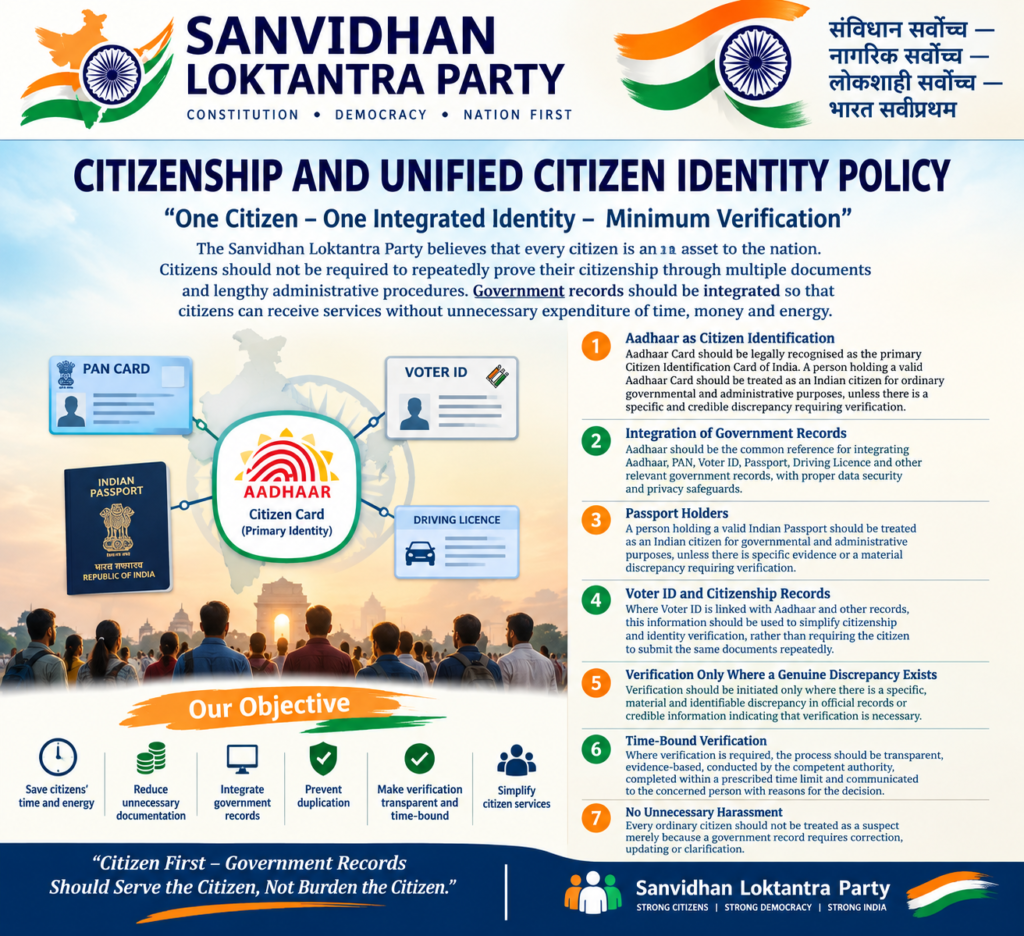
“One Citizen – One Integrated Identity – Minimum Verification”
The Sanvidhan Loktantra Party believes that ordinary citizens should not be required to repeatedly prove their citizenship through multiple documents and lengthy administrative procedures. Government records should be integrated so that citizens can receive services without unnecessary expenditure of time, money and energy.
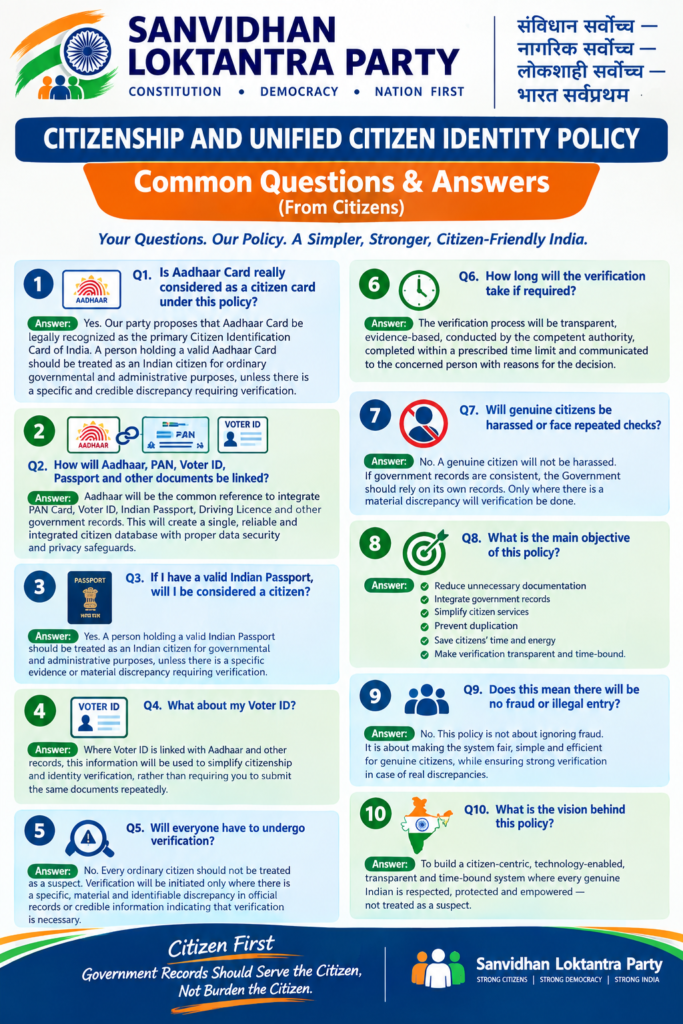
1. Aadhaar as Citizen Identification
The Party proposes that Aadhaar Card should be legally recognized as the primary Citizen Identification Card of India, subject to appropriate amendments in law.
“Aadhaar should be the primary digital identity for government services, while Indian citizenship should be maintained and verified through an integrated national citizenship database. Aadhaar, passport, voter records, birth records, PAN and other authorised government records should be digitally cross-verified, without making any single identity document conclusive proof of citizenship.”
A person holding a valid Aadhaar Card should be treated as an Indian citizen for ordinary governmental and administrative purposes, unless there is a specific and credible discrepancy requiring verification.
2. Integration of Government Identity Records
Aadhaar should serve as the common identification reference for integrating:
- Aadhaar Card
- PAN Card
- Voter ID
- Indian Passport
- Driving Licence and other relevant government records
The objective is to create a single, reliable and integrated citizen database, while maintaining appropriate privacy and data-security safeguards.
3. Passport Holders
A person holding a valid Indian Passport should be treated as an Indian citizen for governmental and administrative purposes, unless there is specific evidence or a material discrepancy requiring verification.
4. Voter ID and Citizenship Records
Where a person’s Voter ID is linked with Aadhaar and other government records, the information should be used to simplify citizenship and identity verification rather than requiring the citizen to repeatedly submit the same documents.
5. Verification Only Where a Genuine Discrepancy Exists
The Government should not require every ordinary citizen to repeatedly establish his or her citizenship.
Verification should be initiated only where there is a specific, material and identifiable discrepancy in official records or credible information indicating that verification is necessary.
6. Time-Bound Verification
Where verification is required, the process should be:
- transparent;
- evidence-based;
- conducted by the competent authority;
- completed within a prescribed time limit 6 months; and
- communicated to the concerned person with reasons for the decision.
7. No Unnecessary Harassment of Citizens
A citizen should not be treated as a suspect merely because a government record requires correction, updating or clarification.
The principle should be:
“Every ordinary citizen should not be required to prove his citizenship again and again. Where official records are consistent, the Government should rely on its own records. Where a genuine discrepancy exists, verify it and take a reasoned decision.”
8. Objective of the Policy
This policy aims to:
Reduce unnecessary documentation → Integrate government records → Simplify citizen services → Prevent duplication → Save citizens’ time and energy → Make verification transparent and time-bound.
Party Principle
“Citizen First – Government Records Should Serve the Citizen, Not Burden the Citizen.”
The Party proposes that citizenship verification should become a simple, technology-based, transparent and time-bound administrative process, while preserving the legal safeguards necessary to prevent fraud and protect national interests.
“What problems, risks or safeguards do you think should be added to this policy?”