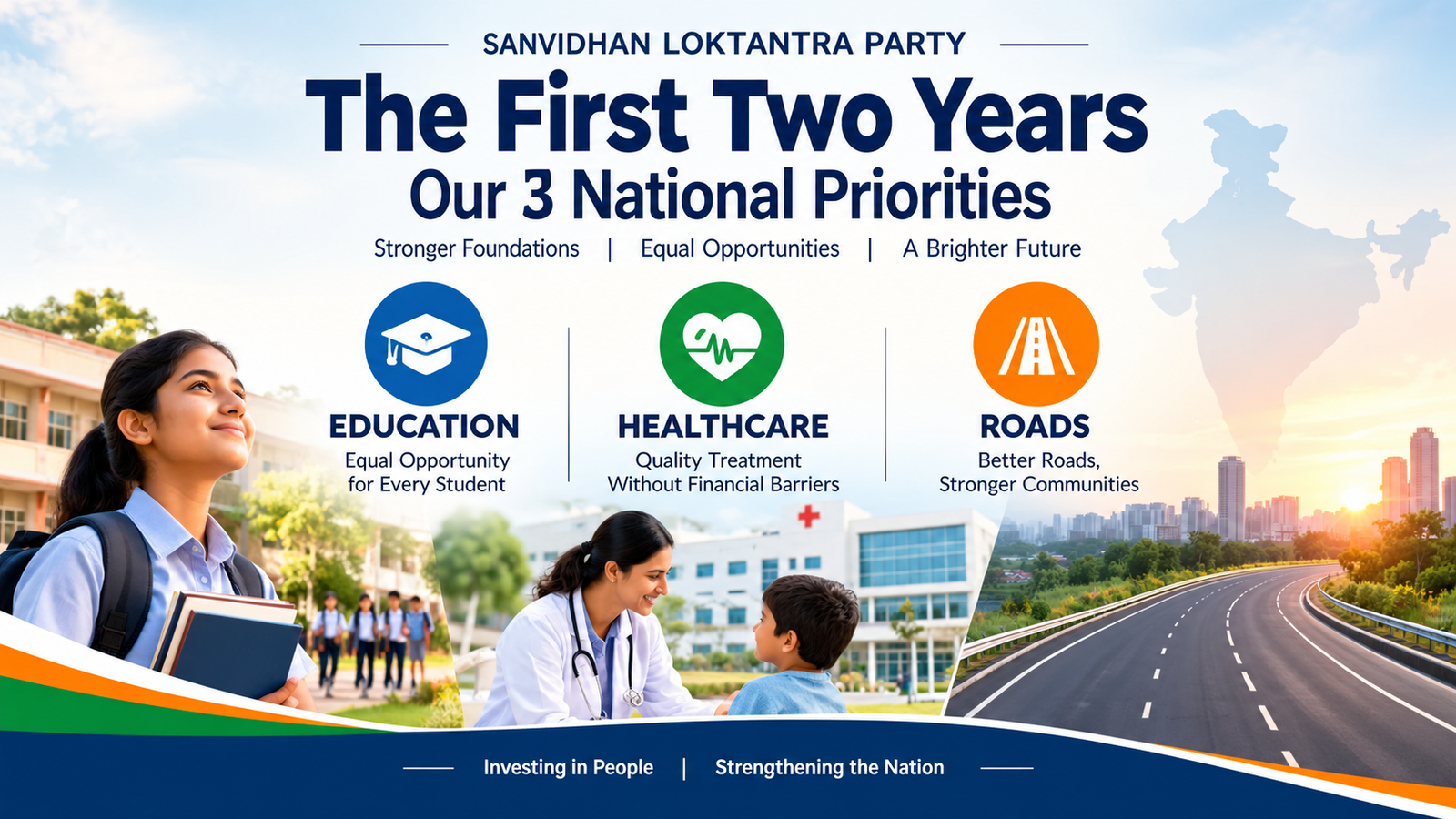
The First Two Years: Three National Priorities
During the first two years in government, our Party will focus primarily on three basic areas that directly affect the quality of life and future opportunities of every citizen:
- Education
- Healthcare
- Roads and Essential Public Infrastructure
The objective of these first two years will not be to make unlimited promises or announce large numbers of new projects. The priority will be to strengthen the existing system, remove unnecessary burdens on citizens, and create a sustainable system that provides equal opportunities across India.
1. EDUCATION
Equal Opportunity — Quality Education — Education Without Financial Dependence
Our education policy will be implemented in stages, with the objective of creating a system in which a student’s educational opportunity is not determined by the financial capacity of his or her parents.
A. Reduce the Unnecessary Academic Burden on Students
The first priority will be to examine and reduce unnecessary academic pressure on children and students.
The present system often requires students to prepare for multiple examinations for admission to different courses and institutions. This creates additional financial, academic and mental pressure on students and families.
Our objective will be to develop a simpler, transparent and merit-based national admission system, wherever a common system is appropriate.
B. Common National Academic Standards
Except for language subjects, fundamental subjects such as:
- Mathematics
- Science
- Economics
- History
- Geography
- and other core academic subjects
will have common national academic standards and a common core curriculum.
At the same time, India is a country of diverse languages, cultures, histories and geographical conditions. Therefore, the curriculum for History and Geography will maintain an appropriate balance between national/global knowledge and local knowledge.
Proposed structure:
- 50% — India and the World
- 50% — State and Local/Regional History and Geography
This will ensure that students develop both a national and global understanding while remaining connected to their own state and local area.
The objective is to ensure that a student receives comparable basic academic opportunities irrespective of the State or region in which the student studies.
C. One National Class XII Examination
A system will be developed under which the Class XII examination is conducted nationally at the same time and according to common academic standards.
The Class XII result will become an important basis for admission to higher and professional education.
Admission to courses such as:
- Engineering
- Medicine
- Technology
- Professional courses
- and other higher-education programmes
will, wherever appropriate, be based on the student’s merit in the common examination and the applicable course-specific academic requirements.
The objective is to reduce the need for students to repeatedly appear for multiple entrance examinations and to create a more transparent and comparable system of merit.
D. Strengthen Educational Infrastructure Within Two Years
A common curriculum and examination system can succeed only when educational infrastructure is also strengthened.
Therefore, during the first two years, a national infrastructure improvement programme will be undertaken for schools and educational institutions.
Priority will be given to:
- Safe and quality school buildings
- Classrooms
- Libraries
- Science and computer laboratories
- Sports and physical education facilities
- Drinking water
- Clean and adequate toilets
- Electricity
- Digital and technological facilities
- Other essential educational infrastructure
The objective will be to establish measurable standards and a two-year action plan for improving educational infrastructure throughout the country.
Infrastructure Financing
Educational institutions requiring infrastructure development may receive financial assistance in the form of institutional infrastructure finance/credit, subject to prescribed standards, accountability and repayment conditions.
The institution may repay such infrastructure finance over a defined period, proposed to be up to five years, subject to the final rules.
Institutions may also use legally permitted sources such as:
- A reasonable development contribution, within prescribed limits
- Donations
- Corporate Social Responsibility (CSR) funds
- Institutional deposits and other permitted sources
The objective is to create durable infrastructure without placing an excessive financial burden directly on students.
E. EDUCATION CREDIT CARD
“Take Education Today — Repay Through Your Future Taxes”
The most important part of our education policy will be the proposed Education Credit Card.
This is fundamentally different from a conventional scholarship and is also different from a traditional education loan.
The Basic Concept
Every eligible student will be provided with an Education Credit Card connected to a National Tax Credit Account.
The Education Credit Card will enable a student to meet eligible educational expenses today, while the corresponding amount can be recovered gradually from the student’s future tax contributions.
In simple words:
“Take your education today and repay it through your future taxes.”
The purpose is to give a student the ability to invest in his or her own education and future earning capacity.
How the Concept Will Work
Under the proposed system:
Step 1 — Education Today
A student uses the Education Credit Card for eligible educational expenses.
Step 2 — Credit is Recorded
The amount used for education is recorded against the student’s National Tax Credit Account.
Step 3 — Student Completes Education
The student can complete higher education without having to arrange the entire cost immediately through the family.
Step 4 — Student Enters Employment/Business
After completing education, the student earns income through employment, profession or business.
Step 5 — Future Tax Contribution
When the student becomes liable to pay applicable taxes, the eligible amount used for education can be adjusted/recovered progressively from the student’s future tax liability, according to prescribed rules.
Thus, the fundamental principle is:
“Do not depend entirely on your parents’ financial capacity to study. Build your future through education and repay the cost from your future tax contribution.”
F. National Tax Credit Account
The proposed National Tax Credit Account will create a connection between taxation and long-term investment in an individual’s education and healthcare.
Where parents or the student have paid eligible taxes such as:
- Income Tax
- GST, where legally attributable and eligible under the system
- Stamp Duty
- and other eligible tax contributions
the applicable credit may be recorded according to the rules of the National Tax Credit system.
Such credit can be used for eligible education and healthcare purposes.
At the same time, the Education Credit Card mechanism will allow a student to access eligible educational expenditure even where sufficient previous tax credit is not available, subject to the prescribed limits and repayment mechanism.
Therefore, the system is intended to operate on the principle of future tax-backed educational credit, rather than simply providing a government grant.
G. No Student Should Lose Education Because of Family Poverty
A student’s future should not be permanently determined by the financial condition of his or her parents.
Under the proposed Education Credit Card system, a capable student should be able to pursue education even when the family cannot immediately bear the entire cost.
The objective is therefore:
No child should have to abandon education merely because the family does not have enough money today.
The student receives the opportunity today and contributes toward the cost through his or her future economic participation and eligible tax payments.
This creates a different relationship between the citizen and the State:
Education is not merely an expenditure by the government; it is an investment in the future earning capacity of the citizen.
2. HEALTHCARE
Quality Treatment Today — Sustainable Payment Through the Future
The same basic principle will be considered for healthcare through the proposed National Tax Credit Account.
A citizen should not be forced to postpone essential medical treatment merely because sufficient money is not immediately available.
National Healthcare Credit
Eligible healthcare expenditure may be supported through the proposed credit mechanism, allowing eligible citizens to obtain necessary treatment today and adjust/recover the applicable amount through the prescribed future tax-credit/tax-liability mechanism.
The broad principle will be:
“Get necessary treatment today; contribute toward its cost through your future economic participation and eligible taxes.”
This will require appropriate safeguards, eligibility conditions, treatment limits, fraud prevention mechanisms and transparent accounting.
A. Modernise Government Hospitals
Government hospitals in many areas already provide essential healthcare services. The objective will be to transform them into modern, well-equipped and professionally managed public healthcare institutions.
During the first two years, priority will be given to:
- Modern medical equipment
- Diagnostic facilities
- Emergency services
- Operation theatres
- ICU and critical-care facilities
- Clean and hygienic premises
- Adequate medicines
- Digital health systems
- Qualified medical and support staff
- Patient-friendly systems
- Transparent monitoring of service quality
The objective is to make government healthcare facilities sufficiently modern and reliable so that citizens have a genuine public healthcare option alongside private healthcare.
3. ROADS
Repair First — Build Better — Maintain Continuously
During the first two years, the primary focus will not be on constructing large numbers of new roads.
Instead, priority will be given to improving the condition, quality and durability of existing roads.
A. Upgrade Existing Roads
Existing roads will be surveyed and classified according to their condition.
Where necessary, roads will be reconstructed or scientifically repaired rather than repeatedly carrying out temporary patchwork.
The objective will be to use appropriate engineering standards and materials so that repaired roads remain serviceable for a long period under normal conditions.
B. Monthly Road Inspection
Road maintenance will become a continuous responsibility, rather than an activity undertaken only after roads become severely damaged.
A systematic inspection mechanism will be established for:
- Monthly road inspections
- Immediate repair of small defects
- Pothole identification and repair
- Drainage inspection
- Pre-monsoon inspection
- Post-monsoon assessment
- Quality monitoring of road works
- Accountability of contractors and responsible authorities
Small defects should be identified and repaired before they become major and expensive problems.
The Principle
“Do not wait for a road to completely fail before repairing it.”
Regular preventive maintenance can protect public investment, reduce repeated expenditure and improve road safety.
THE FIRST TWO YEARS — OUR BASIC PRIORITY
Our first two years will therefore focus on building the foundations of a stronger India.
EDUCATION
Equal opportunity for every student.
HEALTHCARE
Access to quality treatment without immediate financial barriers.
ROADS
Quality existing roads with continuous maintenance.
Our approach is based on a simple principle:
Build the foundation first. Create systems that are sustainable. Give citizens opportunities today and enable them to contribute to the nation through their future economic participation.
Our Vision
Education should create opportunity.
Healthcare should protect human life.
Roads should support economic activity.
The first two years will be dedicated to strengthening these three foundations so that the country can move toward broader economic and social reforms on a stronger base.