 SANVIDHAN LOKTANTRA PARTY
Every Suitable Home – Solar Energy | Every Family – Lower Energy Cost | India – Energy Independent
Our Vision
India spends a substantial amount of foreign exchange on imported petroleum, gas and other fossil fuels. At the same time, India has enormous solar-energy potential.
Sanvidhan Loktantra Party proposes a national transition from imported fossil-fuel consumption to locally generated renewable electricity.
Our objective is simple:
“Use India’s Sun to reduce India’s dependence on imported Oil and Gas.”
1. Solar Energy for Every Suitable Citizen
The Government will establish a National Solar Energy for Every Home Programme.
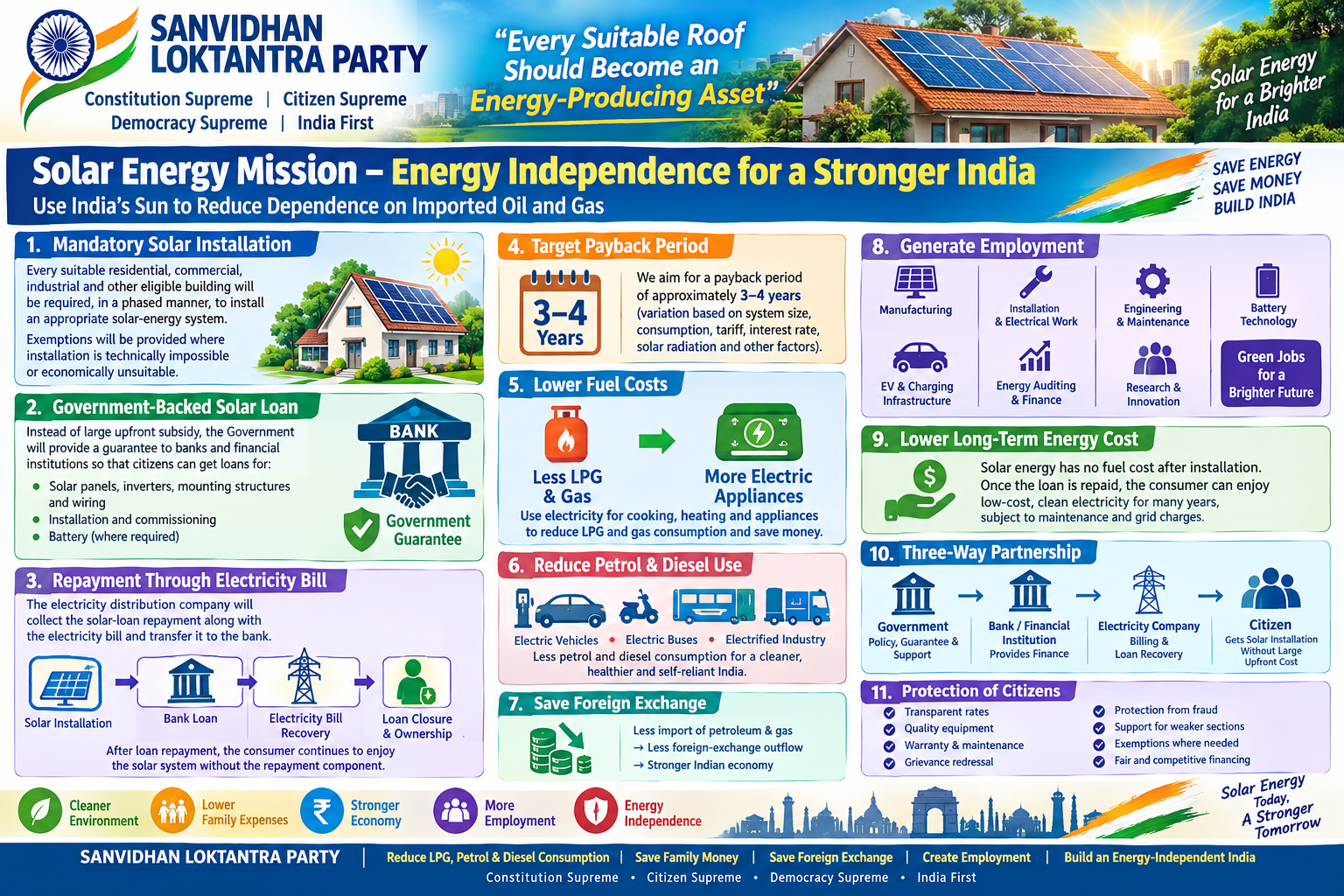
Every suitable residential house, apartment, commercial establishment, industrial premises and other eligible building will be required, in a phased manner, to install an appropriate rooftop or other solar-energy system.
The programme will particularly encourage the replacement of:
- LPG and other gas-based household appliances with efficient electric appliances;
- petrol/diesel vehicles with electric vehicles;
- fossil-fuel-based industrial equipment with electric alternatives wherever technically feasible.
The policy will be implemented with appropriate exemptions for buildings or premises where solar installation is technically impossible or economically unsuitable.
2. Replace Capital Subsidy with Government-Backed Financing
Instead of continuing a large upfront subsidy, the Government may gradually replace the existing capital subsidy model with a Government-Guaranteed Solar Loan Programme.
The Government will provide a guarantee mechanism through designated banks and financial institutions so that eligible citizens can obtain loans for:
- Solar panels;
- Inverters;
- Mounting structures;
- Wiring and electrical equipment;
- Batteries, where required;
- Installation and commissioning.
- The citizen will therefore not need to arrange the entire installation cost upfront.
3. Repayment Through the Electricity Bill
The most important feature of our policy will be the “Solar Loan Through Electricity Bill” mechanism.
The bank will finance the solar installation.
The electricity distribution company will collect the applicable solar-loan repayment amount along with the consumer’s electricity bill and transfer the repayment to the lending bank.
Therefore:
Solar Installation → Bank Loan → Solar Electricity Generation → Electricity Bill → Loan Recovery → Loan Closure
The consumer will gradually repay the installation cost through the electricity-billing mechanism.
After completion of the loan:
The consumer continues to enjoy the benefit of the solar system without the loan repayment component.
4. Short Payback Period
The Government will design the financing structure with the objective of achieving a target payback period of approximately 3–4 years wherever technically and financially feasible.
The actual period may vary according to:
- system capacity;
- electricity consumption;
- solar radiation;
- installation cost;
- interest rate;
- electricity tariff;
- maintenance cost; and
- applicable net-metering or other regulatory arrangements.
5. Government Guarantee – Minimum NPA Risk
The Government-backed financing structure will substantially reduce the credit risk faced by banks.
Since the repayment is connected with the electricity-billing system, the loan recovery mechanism becomes more systematic than an ordinary unsecured consumer loan.
The policy should also provide suitable safeguards for:
- transfer of ownership of the property;
- sale of the property;
- change of electricity consumer;
- temporary disconnection;
- non-payment of electricity bills;
- insolvency or death of the borrower; and
- defective or non-performing solar equipment.
The objective will be:
Affordable financing + electricity-bill recovery + Government guarantee = low-cost solar expansion with controlled banking risk.
6. Reduce LPG and Gas Consumption
Once reliable solar electricity becomes available, families can progressively shift suitable household activities from gas to electricity.
For example:
Solar Electricity → Electric Cooking / Heating / Appliances → Lower LPG Consumption
This can reduce the recurring expenditure of families on LPG and other fuels.
The saving generated from reduced fuel expenditure can help the family meet the solar-loan repayment.
7. Reduce Petrol and Diesel Consumption
The same policy will promote the transition towards:
- Electric two-wheelers;
- Electric three-wheelers;
- Electric cars;
- Electric buses;
- Electric commercial vehicles; and
- Electrified industrial equipment.
As electricity generation increasingly comes from domestic renewable sources, India can reduce its dependence on imported petroleum products.
8. Save Foreign Exchange
India imports a significant amount of its petroleum requirements.
Therefore, reducing unnecessary consumption of imported petrol, diesel and gas can help:
Reduce Fossil-Fuel Imports
↓
Reduce Foreign-Exchange Outflow
↓
Improve Energy Security
↓
Strengthen the Indian Economy
Money presently spent on imported fuel can increasingly remain within the Indian economy.
9. Generate Employment
The Solar Energy Mission will create large-scale employment opportunities in:
- Solar manufacturing;
- Installation;
- Electrical work;
- Engineering;
- Maintenance;
- Battery technology;
- Electric vehicles;
- Charging infrastructure;
- Energy auditing;
- Financing;
- Solar-system servicing; and
- Renewable-energy research.
Thus, the programme will create both energy independence and employment opportunities.
10. Lower the Long-Term Cost of Energy
Solar energy has no fuel cost after installation.
Therefore, once the installation loan is repaid, the consumer can obtain electricity from his or her own solar-generation system at a substantially lower long-term marginal energy cost, subject to maintenance and applicable grid charges.
Our objective is:
“Pay for the Solar System once — generate energy for many years.”
11. A New Partnership Between Government, Banks and Electricity Companies
The Sanvidhan Loktantra Party proposes a three-party implementation mechanism:
GOVERNMENT
→ Provides policy, guarantee and institutional support
BANK / FINANCIAL INSTITUTION
→ Provides solar installation finance
ELECTRICITY DISTRIBUTION COMPANY
→ Facilitates billing-based recovery and grid integration
CITIZEN
→ Gets solar installation without a large upfront financial burden and ultimately owns the system.
12. Protection of Citizens
Mandatory solarisation will not mean forcing citizens to bear an unaffordable financial burden.
The Government will ensure:
- transparent installation rates;
- approved-quality equipment;
- competitive financing;
- warranty protection;
- maintenance standards;
- grievance-redressal mechanisms;
- protection against fraudulent solar companies;
- special provisions for economically weaker households; and
- exemptions wherever installation is technically impossible.
Our National Objective
The Sanvidhan Loktantra Party believes that India’s energy policy should move from:
Imported Oil & Gas → Domestic Solar & Renewable Energy
Monthly Fuel Expense → Long-Term Energy Ownership
Foreign-Exchange Outflow → Domestic Investment
Fossil-Fuel Jobs → Green-Energy Jobs
Energy Dependence → Energy Independence
Our Promise
“Every Suitable Roof Should Become an Energy-Producing Asset.”
“Every Family Should Have the Opportunity to Generate Its Own Electricity.”
“Reduce LPG, Petrol and Diesel Consumption — Save Family Money — Save Foreign Exchange — Create Employment — Build an Energy-Independent India.”
SANVIDHAN LOKTANTRA PARTY
Constitution Supreme — Citizen Supreme — Democracy Supreme — India First
Our Energy Policy:
Sunlight of India → Electricity of India → Savings of Indian Families → Strength of Indian Economy