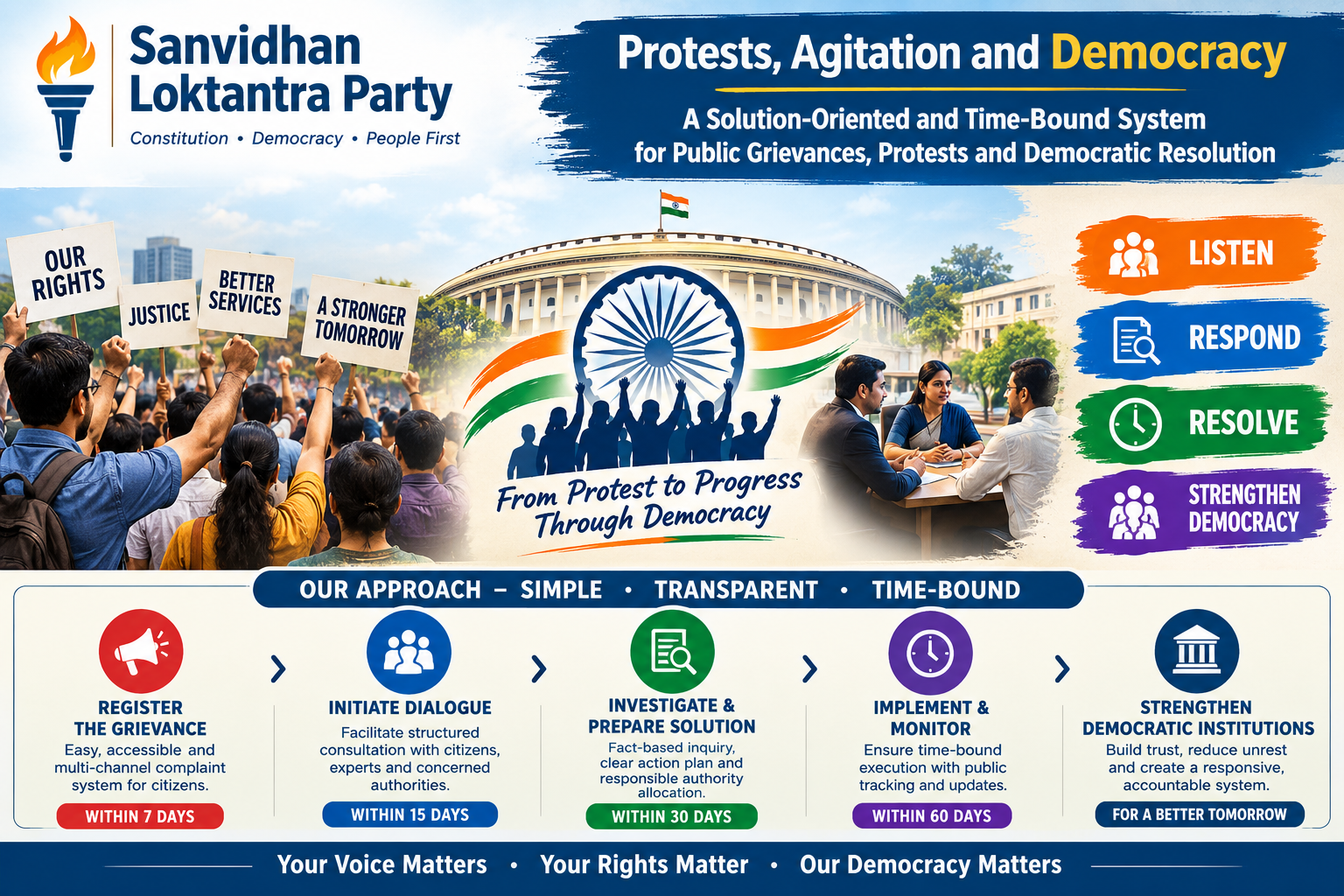
Objective: A Solution-Oriented and Time-Bound System for Public Grievances, Protests and Democratic Resolution
Our Core Objective
The Indian Sanvidhan Loktantra Party believes that the greatest weakness in the present democratic system is that citizens can raise a serious problem, and the Government can defend its position, but neither side is necessarily required to place a practical and workable solution on the table.
A protest may continue for months, while the Government and protesters remain in disagreement. Political demands may focus on the resignation of a Minister or Government, while the actual problem remains unresolved.
This is a major gap in democracy
For example, if citizens protest against leakage, corruption, examination irregularities or any other public problem, simply demanding the resignation of a Minister does not automatically stop the leakage. Equally, the Government cannot merely reject the allegation without providing a credible mechanism to prevent the leakage.
The real question in a democracy should therefore be
- What is the problem?
- What caused it?
- What are the possible solutions?
- Which solution is the best?
- Who will implement it?
- By when?
- And who will be accountable if it is not implemented?
Our Party proposes to make this Solution-Oriented Democracy a fundamental part of governance
- Problem-Based Politics Must Become Solution-Based Politics
Every legitimate public protest should identify:
- the actual problem;
- the cause of the problem;
- the persons/institutions responsible, where established by evidence;
- the impact on citizens and the nation;
- the relief being sought; and
- one or more practical alternative solutions.
A protest should not remain limited to slogans, allegations, resignation demands or opposition to a particular person.
Our principle is:
“Do not only tell the Government what is wrong. Tell the Government how it can be made right.”
- Government Must Also Provide a Solution
The Government shall not merely reject a protester’s allegation or demand.
If the Government disagrees with the protester’s proposed solution, it should provide:
- the reasons for disagreement;
- the facts and evidence supporting its position;
- its own alternative solution; and
- a clear implementation plan.
Therefore, both sides must bring solutions to the table.
The democratic process should become:
Problem → Evidence → Alternatives → Examination → Best Solution → Implementation → Accountability
- The Protester Shall Not Be Required to Find the Entire Solution Alone
The Party does not propose to place an unreasonable burden on ordinary citizens.
A citizen may not have technical, financial, legal or administrative expertise.
Therefore, the citizen or protester should provide reasonable alternative solutions wherever possible, while the Government must provide technical, legal and administrative assistance to examine those alternatives.
The objective is co-creation of solutions, not shifting the Government’s responsibility onto citizens.
4. Sixty-Day Pre-Protest Resolution Period
Before commencing a major protest or hunger strike concerning a public grievance, the concerned citizens, organisation or political party should ordinarily give the Government 60 days to resolve the issue.
During this period:
- the grievance shall be formally submitted;
- alternative solutions shall be provided wherever reasonably possible;
- the Government shall examine the grievance;
- the Government shall discuss the proposed solutions;
- the Government shall provide its own alternatives where necessary;
- both sides shall attempt to identify the best lawful and practical solution; and
- where necessary, a Common Resolution Committee shall be constituted.
The purpose is simple:
If a problem can be solved without a protest, democracy should solve it before the protest begins.
5. Government Must Not Use the 60 Days for Delay
The 60-day period shall not become an excuse for administrative delay.
The Government must actively attempt to resolve the issue during this period.
If the Government deliberately avoids discussion, fails to examine the alternatives, or simply allows the 60 days to expire without meaningful action, the concerned citizens shall retain their lawful right to peaceful protest.
6. If the Issue Is Still Unresolved, the Time-Bound Protest Mechanism Begins
If the issue remains unresolved after the prescribed pre-protest process and a lawful peaceful protest or hunger strike begins:
Within 3 days
The Government must begin formal discussion.
Next 3 days
The Government and protesters must make a genuine joint effort to resolve the issue.
If still unresolved
A mandatory Nine-Member Joint Committee shall be constituted.
- Nine-Member Joint Committee
The Committee shall consist of:
- 3 representatives of the ruling party;
- 1 representative of the principal opposition party;
- 3 representatives of the protesting citizens/organisation;
- 1 retired Judge; and
- 1 subject expert, journalist or retired senior Government officer.
The Committee shall examine both the grievance and the proposed solutions.
It shall not merely decide whether the protester’s demand is right or wrong.
Its principal question shall be:
“What is the best lawful, constitutional, practical and sustainable solution to this public problem?”
- No Party Can Block the Committee
Participation shall be mandatory.
If any party fails or refuses to nominate its representative, the other members shall proceed with the Committee.
No party shall be allowed to defeat the democratic process simply by refusing to participate.
The concerned Government Department shall be responsible for ensuring that the Committee functions.
- Independent Legal and Constitutional Examination
Where the issue involves complicated legal or constitutional questions, an independent retired Judge with relevant experience may assist the Committee.
Where necessary, appropriate legal and constitutional assistance may be sought through the legally prescribed mechanisms.
The purpose shall be to ensure that the proposed solution is:
- constitutional;
- legally valid;
- practically implementable;
- financially sustainable; and
- in the public interest.
- The Best Alternative, Not the Loudest Demand
The Government should not automatically accept a demand merely because the protest is large.
Similarly, the Government should not reject a demand merely because it comes from the opposition.
The solution should be selected on the basis of:
Constitution + Law + Evidence + Public Interest + Practicality + Financial Feasibility + Long-Term National Interest.
This is the difference between majority politics and responsible democracy.
- Example: A Protest About Leakage
Suppose citizens allege that there is leakage of public resources, examination papers, Government funds, information or any other public asset.
The protest should not stop at:
“Minister X should resign.”
The Government should not respond only:
“There is no leakage.”
Instead, both sides should address:
What is leaking?
How is it leaking?
Who is responsible?
What evidence exists?
How can the leakage be stopped immediately?
What system changes are required?
What technology can prevent it?
What independent monitoring is required?
What punishment should apply?
Who will be accountable?
By what date will the solution be implemented?
If resignation is legally and factually justified, that question can also be considered.
But resignation by itself is not a solution to leakage.
Likewise, merely making an allegation of leakage without proposing any reasonable preventive mechanism leaves a major gap in the democratic process.
Our principle is therefore:
“Stop the leakage first; establish responsibility; punish the guilty according to law; and create a permanent system so that the leakage cannot happen again.”